Swedish Government report for digital collaboration platform technologies for the public sector puts Nextcloud front and centre as the key solution in this space

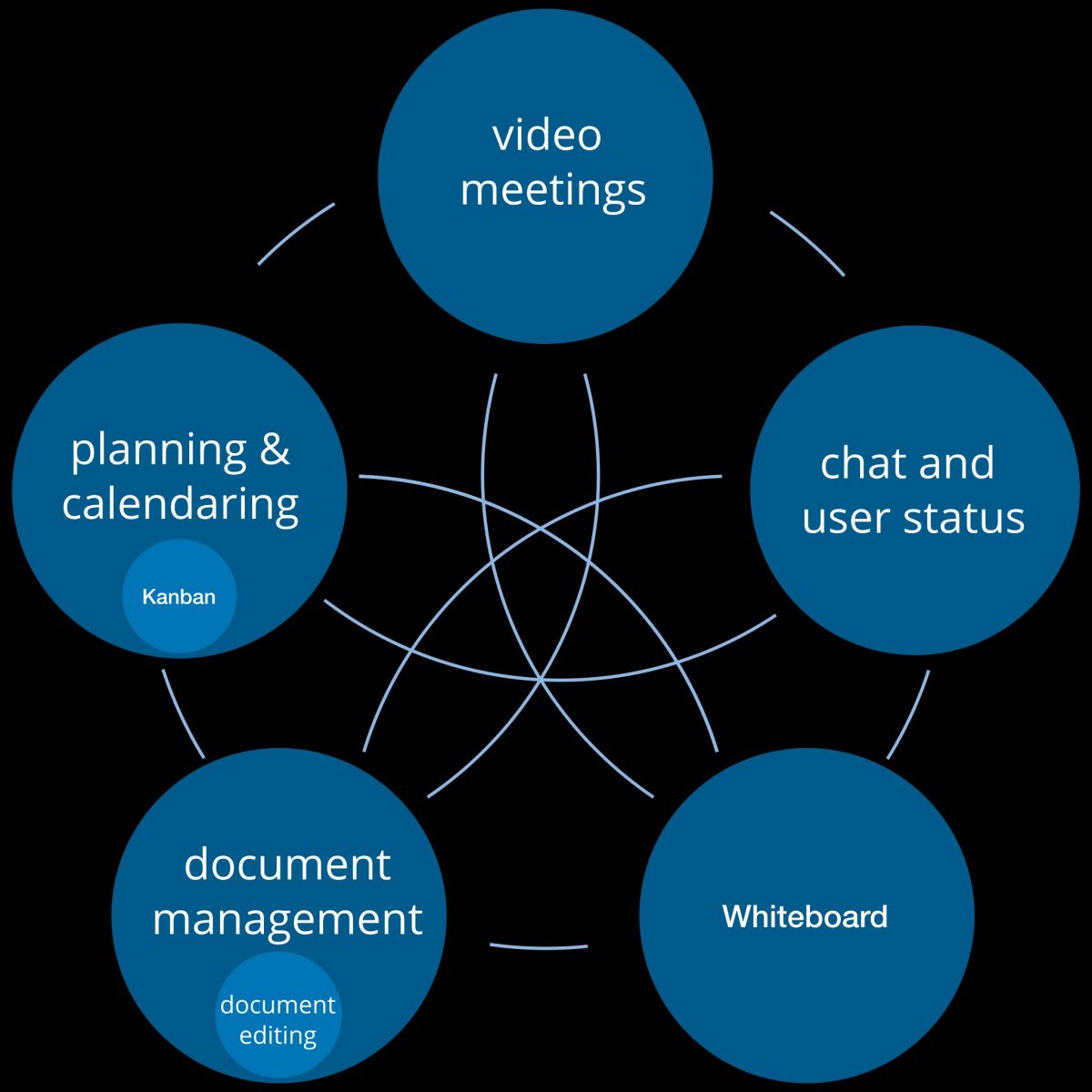
The report was put together by 8 Swedish government agencies, including the Swedish Civil Contingencies Agency, the Swedish Transport Administration, the Swedish Companies Registration Office and the Försäkringskassan. The report gives an exhaustive definition of digital collaboration, noting the important components needed for teams to work together.

Nextcloud is already in use at the Swedish Transport Agency and the Swedish Social Insurance Agency, while Försäkringskassan offers authorities Nextcloud as a service.

See https://nextcloud.com/blog/swedish-government-nextcloud-premier-digital-collaboration-platform/

#technology #opensource #sweden #government #nextcloud

Congratulations to the new German government coalition for their open source strategy!

The new German ‘traffic light’ coalition from SPD, Greens and FDP released the results of weeks of negotiation: their coalition agreement. A key component of this extensive agreement are commitments to furthering the digitalization of the German government, in particular through the use of open source and with an eye towards Digital Sovereignty of the German government.

Some relevant quotes:

„We want to increase the strategic sovereignty of Europe.“

„Municipalities must benefit from federal funds and be able to adopt solutions developed within the framework of the One-for-all principle. (Public Money Public Code)“

„We require open standards for public IT projects. Development contracts should typically be commissioned as open source, the corresponding software is generally made public. On the basis of a multi-cloud strategy and open interfaces as well as strict security and transparency requirements, we are building a public administration cloud.“

„Government data from all administrative levels are to be made available in standardized formats in the future. The agricultural data room in Gaia-X as the basis of a European data infrastructure with clear usage rights for farmers to the farm-specific data, which they helped to create, is being further developed with standardized interfaces. Open source formats are expressly supported.“

See https://nextcloud.com/blog/congratulations-to-the-new-german-government-coalition-for-their-open-source-strategy/

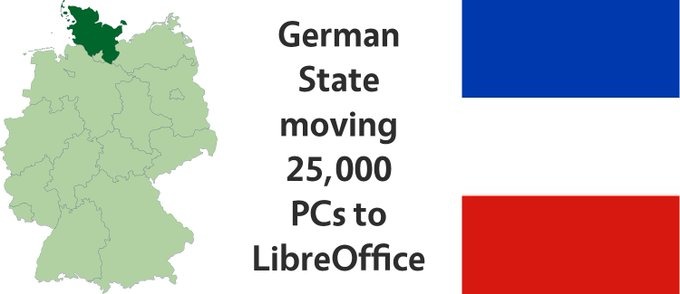
The north-German state of Schleswig-Holstein plans to switch to open source software, including LibreOffice, in its administration and schools

In doing so, the state wants to reduce its dependence on proprietary software, and eventually end it altogether. By the end of 2026, Microsoft Office is to be replaced by LibreOffice on all 25,000 computers used by civil servants and employees (including teachers), and the Windows operating system is to be replaced by GNU/Linux.

The necessary steps for this are specified in the planning of the Schleswig-Holstein state parliament (German), as digital minister Jan Philipp Albrecht explains in an interview with c’t.

German State moving to LibreOffice

See https://blog.documentfoundation.org/blog/2021/11/18/german-state-planning-to-switch-25000-pcs-to-libreoffice/

In the spirit of open government, France dumps 9,067 repos online with public sector open-source code, to show off its FOSS credentials

The release happened as a result of a decree of Open Government from 30 October 2019 after the French government joined the Open Government Partnership in April 2014. After two years of work, the site hit version 1.0 on Wednesday.

This really allows further re-use of publicly funded code, and also serves as a boost for their own small businesses who want to make use of it for themselves or to serve their customers.

See https://www.theregister.com/2021/11/11/french_government_foss/

#opensource #opengovernment #france #publicsector

The European Commission adopts its new Open Source Software Strategy 2020-2023

The strategy recognises the importance of collaboration across the Commission, with Member States, companies and the public at large for building new, innovative digital solutions that work across borders and towards technological sovereignty.

“The new open source software strategy is a practical instrument for the digital transformation of the Commission. It is also an important enabler for innovation that will equip us with the knowledge to create a better and even more inclusive digital environment within and beyond our organisation.’’ said Mario Campolargo, acting Director-General of DG Informatics.

See https://ec.europa.eu/info/news/european-commission-adopts-new-open-source-software-strategy-2020-2023-2020-oct-20_en

#technology #opensource #EU

7 open hardware projects working to solve COVID-19

The open source hardware movement has long championed the importance of the right to repair, fully own the technology you buy, and be able to remix and reproduce gadgets, just like you can with music. And so, during this challenging time, open hardware is providing some answers to some of the problems created by the coronavirus pandemic.

These are the projects covered in more detail in the linked article:
* Opentrons says its products can help dramatically scale-up COVID-19 testing with systems that can “automate up to 2,400 tests per day within days of an order being placed.”
* Chai’s Open qPCR device uses polymerase chain reaction (PCR) to rapidly test swabs from surfaces (e.g., door handles and elevator buttons) to see if the novel coronavirus is present.
* OpenPCR – the device aims to democratize access to molecular diagnostics.
* PocketPCR thermocycler is used to activate biological reactions by raising and lowering the temperature of a liquid in small test tubes.
* Open Lung Low Resource Ventilator is a quick-deployment ventilator that utilizes a bag valve mask (BVM), also known as an Ambu-bag, as a core component.
* Pandemic Ventilator is a DIY ventilator prototype.
* Folding at Home is a distributed computing project for simulating protein dynamics, including the process of protein folding and the movements of proteins implicated in a variety of diseases.

A further 8 other projects are also listed at opensource.com/article/20/3/open-hardware-covid19

Top 10 open source tools for working from home including an excellent collaborative online whiteboard app and document editing apps at zero cost

With the current pandemic taking the world by storm and many small businesses having to suddenly cater for working from home, FOSS can provide some excellent tools at zero cost. When you’re away from your colleagues, it’s vital to connect a few times a week, even if it’s just so you have a human connection as you otherwise toil away in solitude.

Covered in the linked post are:

  • Jitsi video conferencing
  • Drawpile collaborative whiteboard
  • Kanban as Trello alternative for projects and task management
  • Joplin personal notes
  • Riot team chat as an alternative to Slack or MS Teams
  • Etherpad to work together on a document
  • Ethercalc to work together on a spreadsheet
  • Nextcloud for file sharing, storage, calendar, video chat
  • LibreOffice for free installation on home computers to edit documents, spreadsheets, presentations in docx or odf formats

These are all free to get small businesses (or large ones) productive without license restrictions where workers must use private computers from home.

See https://opensource.com/article/20/3/open-source-working-home